
Rancho Cordova’s City Council voted 4-1 Monday to approve plans for a 7,500-seat arena and a city land-sale agreement with its developer, a week before it considers a public assistance package that city staff estimate could total $185 million over 35 years.
Council Member Joe Little cast the only no votes. Mayor Garrett Gatewood, Vice Mayor Linda Budge and Council Members David Sander and Siri Pulipati voted yes at the end of a meeting that ran nearly five hours.
The four members in the majority spoke enthusiastically about the arena after a public hearing in which opponents questioned the tax sharing, asked the mayor to sit out the vote and, in one case, promised to vote a council member out of office.
The council voted 5-0 to bring back the financial participation agreement, the contract that spells out the tax sharing, fee relief and public safety support, for consideration Monday, Nov. 2. Assistant City Manager David Kwong told the council the land transaction depends on that agreement. Under the land agreement, the sale cannot close unless the financial agreement is executed and the developer is in good standing under it.
The council also voted 4-1 to introduce the project’s development agreement ordinance. In another 4-1 vote, the council found that no further environmental review was required for the arena design approval and land agreement. City staff said the project fits the growth the city already studied for its 2006 general plan. The city also reviewed updated project studies.
The arena would be the first piece of Downtown DOVA, a roughly 28-acre district planned along Trade Center Drive between Kilgore Road and Sunrise Boulevard. Later phases could add hotels, shops and up to 1,000 homes, according to the city’s staff report. The developer is Rancho Cordova-based KozPure Development, led by co-founders Josh Wood and Charlie Tiwana.
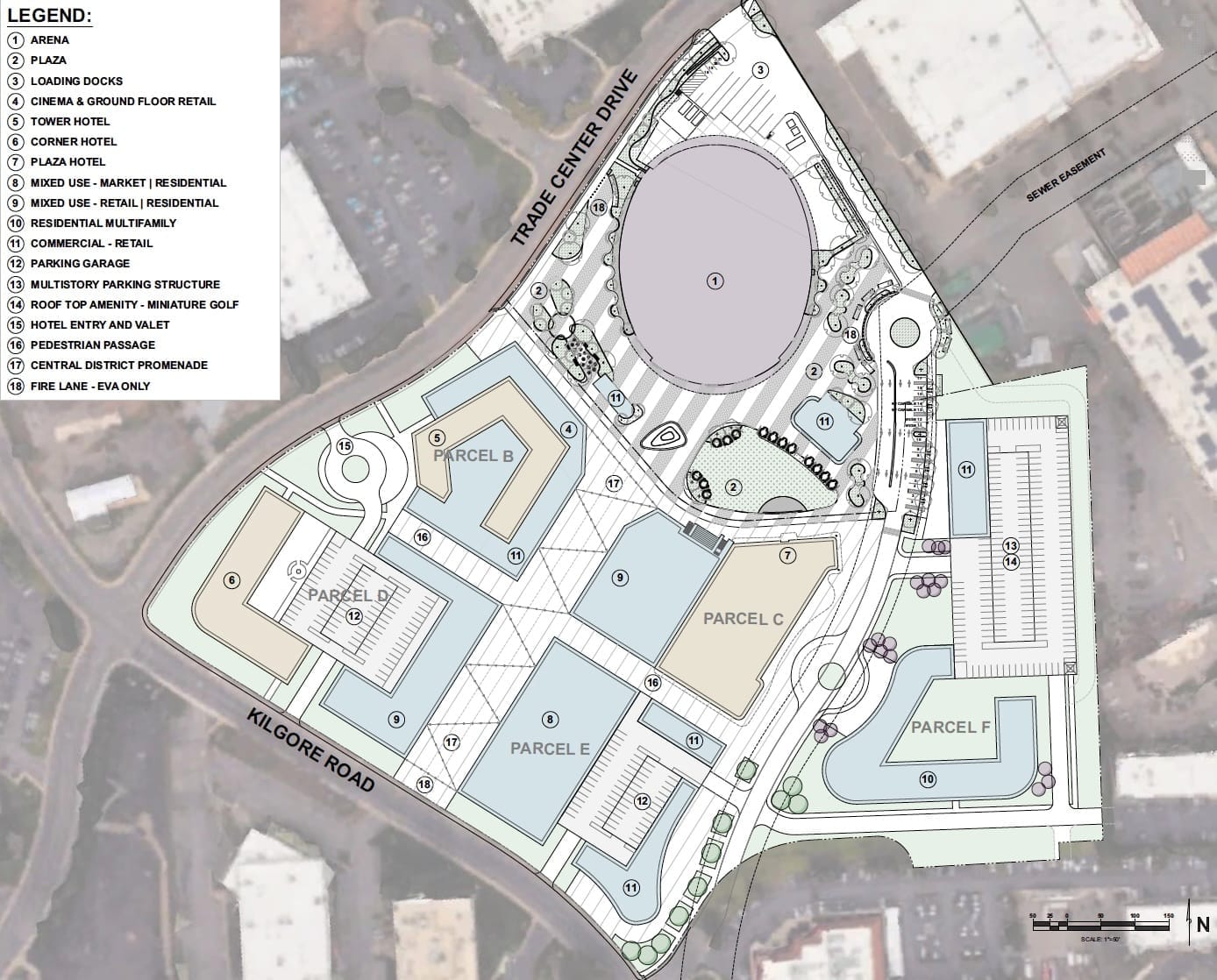
The land agreement sets a baseline price of $3.54 million for the city’s roughly 12.5-acre parcel at 2875 Kilgore Road, based on a May appraisal. A new appraisal will set the final price. The agreement lets that price drop by as much as $600,000, to $2.94 million, to reflect debris and other unsuitable material the buyer would be responsible for removing. The new appraisal could also come in higher.
The city would also lend the developer most of the money for the land. DOVA Arena LLC would pay $300,000 in cash for about 1 acre for the arena’s plaza. Alpha One Sports and Entertainment Group LLC, or a designated affiliate, would buy the remaining 11.5 acres with 20% cash and 80% city financing. The loan would come due 10 years after the second closing, with payments required at least annually.
Kim Juran, an assistant city manager and the city’s chief financial officer, told the council the city would waive up to $3.7 million in building permit processing fees for the arena, hotels and eligible parking improvements. As eligible buildings and improvements reach final inspection, the city would pay up to $13.5 million in development impact fees for arena, hotel, parking and access improvements from its general fund.
Most of the city’s support would come after the district opens, Juran said. Under the proposed 35-year tax-sharing arrangement, the developer would receive half of the city’s 1% sales-tax share from purchases at DOVA. The city would keep all revenue from its Measure H and Measure R sales taxes.
For hotels built on the DOVA project site, the developer would receive all hotel-tax revenue from up to 800 rooms, minus a 2.5% administrative fee retained by the city. For additional hotel rooms built later elsewhere in the broader DOVA zone, the developer would receive half the hotel-tax revenue.
The developer would also receive all cardroom taxes generated by up to 20 tables on the project site, minus a 2.5% administrative fee retained by the city. A cardroom would require separate approvals.
The city would spend up to $15 million on specified police and fire costs for up to 15 years. Police support would start after occupancy approval for 75,000 square feet of non-arena retail or commercial space; fire-related payments would begin after occupancy approval for the 100th residential unit.
The city would not borrow money or guarantee loans for the project, Juran said, but that does not make the project 100% privately funded.
“The city is not serving as a backstop,” Wood told the council. The Oct. 26 staff report does not provide an arena construction budget or identify committed private financing.
“I’m not opposed to the stadium. I don’t think it’s the right location,” Little told the council. Traffic would be “really hard to fix” once the arena is built, he said.
Little said city staff had told council members the deal would likely be “a wash,” with the fee waivers and tax sharing canceling out any economic gain for the city. Staff did not directly address that assertion during the meeting.
Little also objected to approving the land sale before the council sees the final financial agreement. “So why am I voting on half the deal?” Little asked.
Sander countered that the developer would get a share of taxes only if the project is built and brings in money. Discussing what would happen if the project never got built, Sander said claims “that we would be on the hook for $185 million” are “completely untrue.”
“I won’t apologize for believing in Rancho Cordova,” Pulipati said.
Budge counted eight opponents among the 41 people who spoke. “I’ve never heard so much positivity about the future of Rancho Cordova,” Budge said.
Supporters included construction union members and the Rancho Cordova Area Chamber of Commerce. Many said they leave the city for dining and entertainment and would rather have those options in Rancho Cordova.
“Imagine a day when people from Folsom, Sacramento, Elk Grove, Roseville and beyond are the ones driving here,” Simon Evans, who grew up in Rancho Cordova, told the council. “Imagine hearing someone say, ‘Let’s go to Rancho Cordova tonight.’”
Some opponents objected to voting before the final financial agreement is public. “Would any resident in this room sign a binding contract to buy a home without knowing the mortgage rate or financing terms?” Stone Creek resident Marilyn Metzger asked.
“Linda, if you vote for DOVA, we are going to vote you out,” longtime Rancho Cordova resident Matt Cummings told Budge. Budge voted yes.
Two speakers asked Gatewood to sit out the vote over what they called a personal interest in the project. Donielle Cummings said Gatewood handed out T-shirts supporting DOVA at a Planning Commission hearing.
City Attorney Adam Lindgren said no council member had to sit out because the votes were policy decisions and there was “no evidence presented that there’s actually any financial conflicts of interest between any council members and the project or the developer.” The mayor did not directly address the recusal requests in his remarks.
Gatewood praised Wood as a longtime Rancho Cordova resident who chose to build the arena in the city. “I am insulted when people call Josh a developer,” Gatewood said. “He’s a citizen that has chosen Rancho Cordova to develop in.”
“I am 100% behind this project. I cannot wait for it to build,” the mayor said.
“Smile, Josh,” Gatewood told Wood before casting the night’s last vote, on the development agreement. The mayor voted yes.
The development agreement also returns Nov. 2 for possible final adoption.
Project Watch
Keep following: Downtown DOVA
Every story on this project, newest first.
- Rancho Cordova arena advances as city negotiates $185 million in public support
- Rancho Cordova considers hotel assessment to help finance DOVA arena, infrastructurePremium
- Rancho Cordova to consider waiving up to $940,000 in city fees to support proposed 7,500-seat arena projectPremium
Want our stories first on Google? Add Onsite Observer as a preferred source.
Add us on Google →

Comments
What’s your take? Share your thoughts with other readers.