Regulations now account for $131,734 of a new home’s price, builders group says
Government regulations now account for more than a quarter of the price of a new single-family home, according to a newly released study from the National Association of Home Builders, adding another data point to the debate over why new housing remains so expensive to build.
The June 8 study estimates that regulations imposed by federal, state, and local governments account for 26.4% of the final price of an average new single-family home built for sale. Based on an average new-home price of $499,500, NAHB said that equals $131,734 per home.
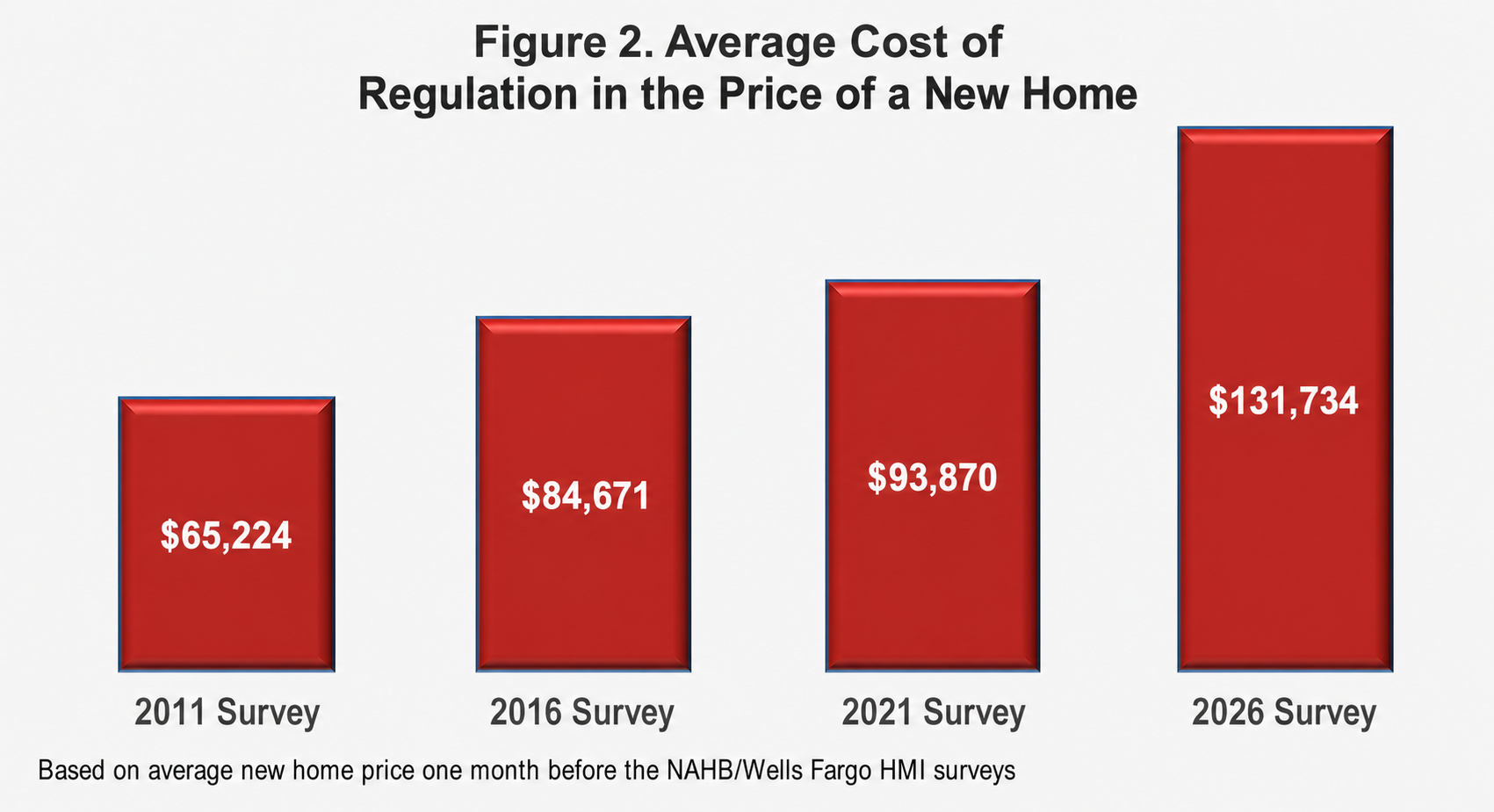
That figure is up sharply from the group’s previous estimates: $93,870 in 2021, $84,671 in 2016, and $65,224 in 2011. In dollar terms, the latest estimate represents a 40% increase since the last survey and roughly double the cost reported 15 years ago.
The findings come as builders, cities, and housing advocates continue to grapple with a shortage of homes and a worsening affordability gap. NAHB, a Washington-based trade association representing home builders, estimates the country has a structural housing deficit of 1.2 million units.
The study does not argue that all regulations should be eliminated. Instead, NAHB said it is attempting to measure the aggregate cost of regulation across the development and construction process, from zoning approvals and land dedications to building codes, permit fees, and regulatory delays.
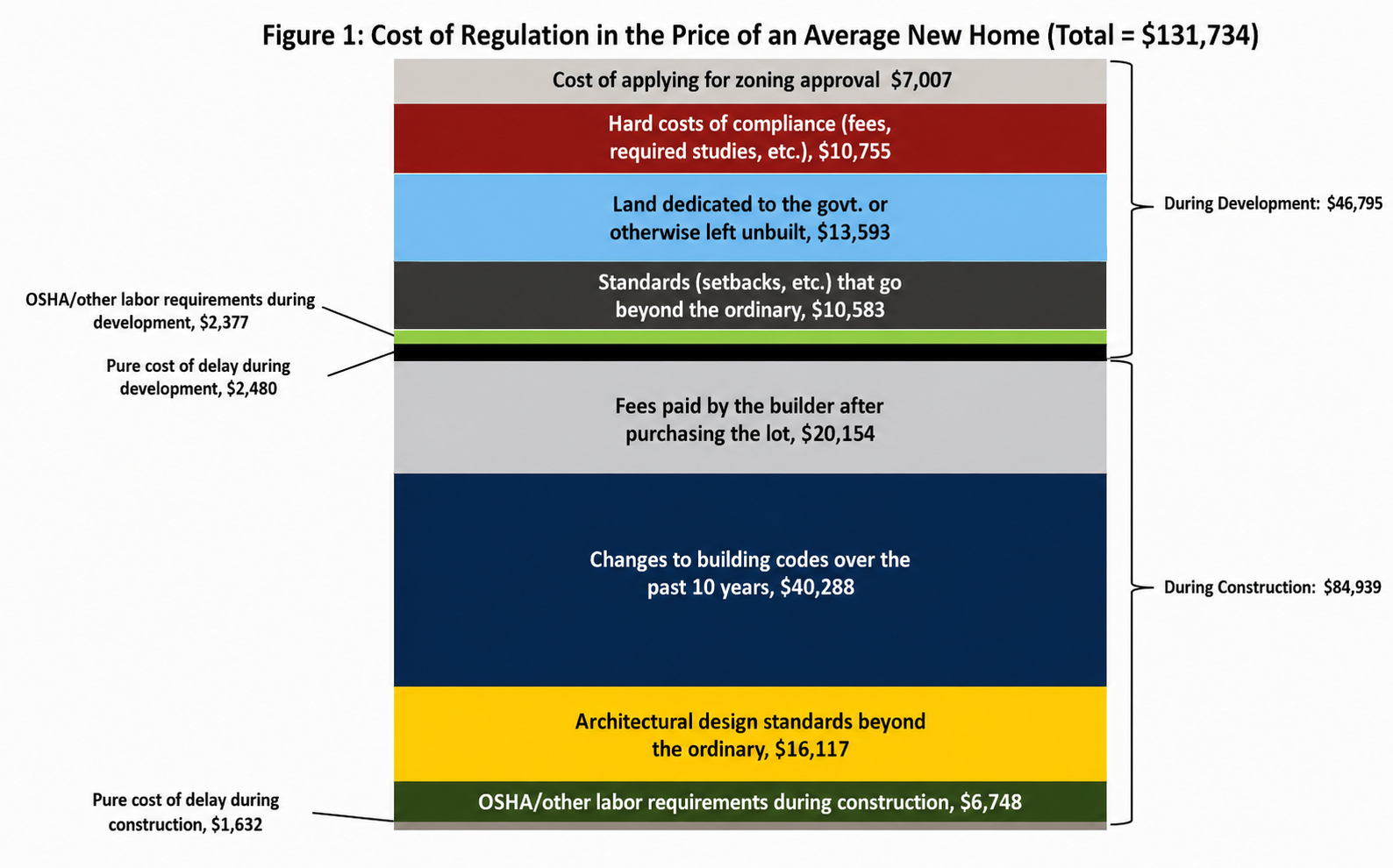
Of the $131,734 in estimated regulatory costs, $46,795 is tied to development of the lot, according to the study. The remaining $84,939 is attributed to regulation during the construction of the home itself.
The largest single category was changes to building codes over the past 10 years, which NAHB estimated added $40,288 to the price of the average new home. Nearly all builders surveyed — 97.4% — said code changes over that period added to their costs.
Fees paid by builders after purchasing a finished lot accounted for another $20,154, while architectural design standards beyond ordinary practice added an estimated $16,117 per home. Those standards can include requirements for siding materials, windows, landscaping, garage orientation, or other design elements that go beyond basic building code compliance.
On the development side, the highest cost came from land that must be dedicated to the government or otherwise left unbuilt, such as for parks or open space. NAHB estimated that the requirement added $13,593 to the final price of a home. Other development-stage costs included $10,755 for compliance costs such as fees and required studies, $10,583 for development standards such as setbacks or landscaping requirements, and $7,007 for zoning approval.
Delays also carry a price, the study found. NAHB said 94.2% of developers reported that regulation caused delays during the development process, averaging about seven months when delays occurred. Among builders, 93.4% said regulation caused delays during construction, averaging a little more than six weeks.
The report is based on two surveys conducted in March. One survey was sent to NAHB members with experience developing single-family lots and selling them to builders, with 54 complete and usable responses. A second set of questions was included in the March 2026 NAHB/Wells Fargo Housing Market Index survey of single-family builders, with 337 complete and usable responses.
NAHB said the surveys were designed to capture costs that builders and developers could reasonably estimate. The report does not break the costs down by federal, state or local government because the group said that is often difficult for builders to determine. Building codes, for example, may be adopted and enforced locally, influenced by state rules and based on national model codes shaped in part by federal agencies.
The study also does not attempt to capture every policy that may affect housing costs. NAHB said broader issues, such as tariffs and immigration policy, can influence prices but are difficult for individual builders to quantify on a project-by-project basis.
The findings are likely to add fuel to ongoing policy fights over how much regulation should be trimmed to make housing easier and cheaper to build. For builders, the study frames regulation as one of several major cost pressures, alongside financing, energy, and materials. For local governments, many of the same rules are tied to infrastructure, safety, environmental review, design standards, and public services needed to support growth.
The size of the estimate underscores how much of the final price of a new home is shaped before a buyer ever signs a contract.
Author

Vitaliy Moskalenko is a development reporter passionate about documenting how communities grow. Through Onsite Observer, he delivers site visits, drone footage, and research-driven stories that bring transparency and context to local development.