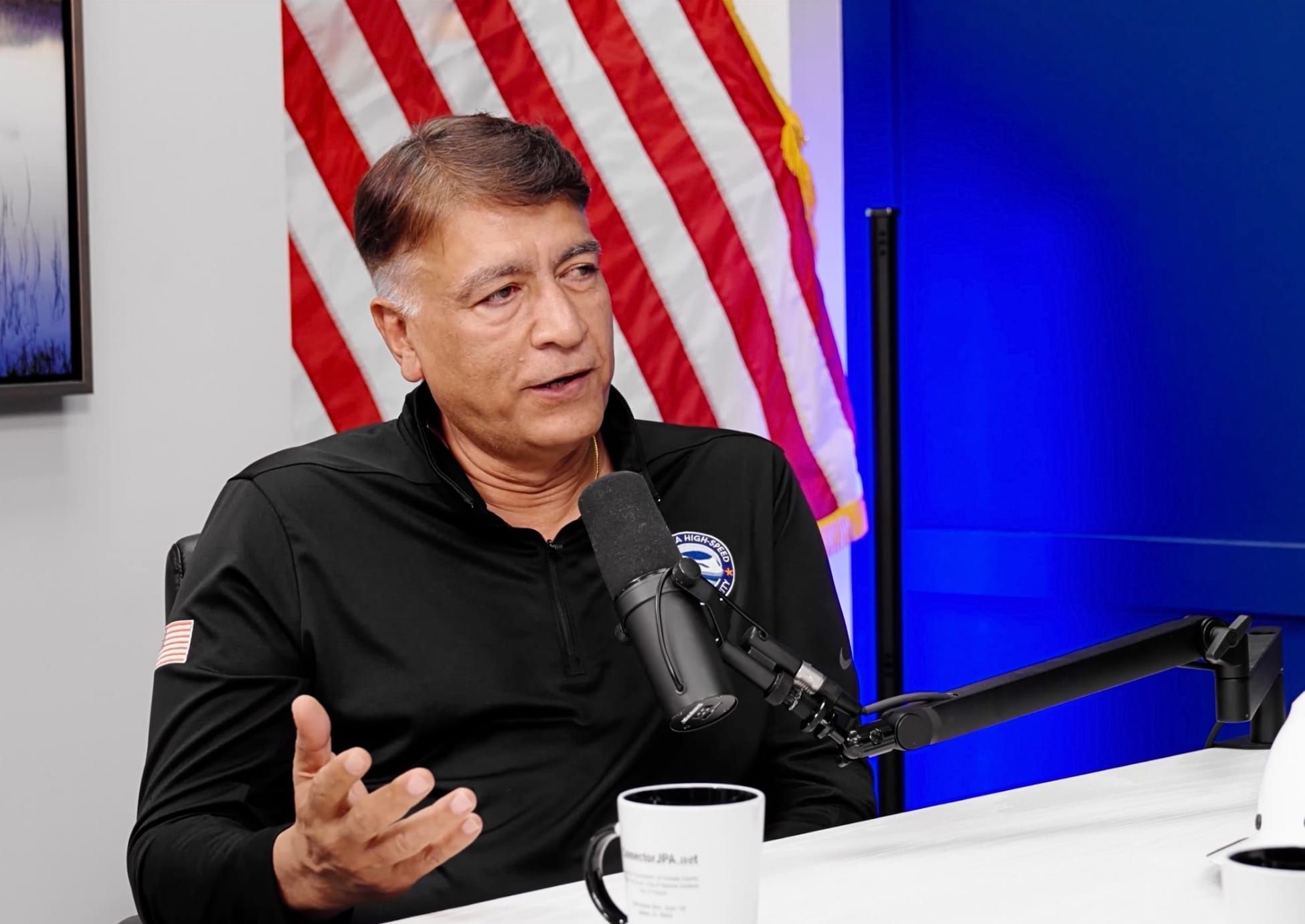
Ian Choudri compared running California's high-speed rail agency to flying a fighter plane over enemy territory with a wing missing and the engine about to fail. The job, he said, was to fix the plane in flight, bring it home and take off again.
Choudri, then chief executive of the California High-Speed Rail Authority, made the comparison Sept. 11 in an interview for "Between Two Shovels," a transportation podcast hosted by Derek Minnema, executive director of the Capital SouthEast Connector Joint Powers Authority. By the time the episode was released Nov. 12, Choudri was no longer running the agency.
On Sept. 15, the inspector general who oversees the project reported that the authority had paid for consultants' trips without the required approvals, often because staff were told, or assumed, that the chief executive or a member of his executive team had requested the travel. On Oct. 9, the authority's board limited Choudri's power over contracts. He resigned Oct. 28.
In the interview, which ran more than an hour, Choudri laid out the case he had been making for the project. Its hardest problems, he argued, were not the bridges and tunnels, which engineers have known how to build since the 1800s, but how the project had been designed, organized, contracted and sequenced.
"We needed to change the way we do business, the way we do contracting, the way we do procurement," he said.
Choudri had spent more than 30 years in transportation and infrastructure, including high-speed rail work in France and Spain, and was a senior vice president at the engineering firm HNTB when the authority's board selected him in August 2024. He said he had followed the California project from the private sector since 2013. When the authority began searching for a new chief executive, he was asked to recommend candidates.
“At some point, the question came, ‘How about you?’”
He took the job because he believed a failure in California would end serious high-speed rail ambitions anywhere in the U.S. "If this one fails, then that's it," he said.
When he took over, Choudri recalled, he believed he already understood 70% to 80% of what lay ahead. It took him six to 10 weeks to realize he had overestimated.
Part of what he found was a railroad designed like a highway. By his account, the authority had been designing for grades of no more than 1.5%, meaning the track rises no more than 1.5 feet over every 100 feet, even though federal rules adopted several years earlier allow lighter trains that can handle 4%. Keeping the line that flat through the mountains meant more and longer tunnels, which he called the slowest and most expensive work on the project. Why hadn't it been changed earlier? "Because no one asks the question," he said.
Choudri attributed much of the project's delay to its early years, when deadlines attached to federal grants pushed the authority to award construction contracts before designs were finished or land was in hand. He estimated that only 10% to 15% of the parcels the authority needed were acquired without litigation. While the rest were tied up in court, contractors arrived with thousands of workers and were shuttled from site to site.
"We keep hopscotching the entire program," he said. If he had been in charge then, Choudri added, he would have paid contractors to demobilize rather than keep thousands of workers on the job with nothing to build. The authority has since secured all 2,288 parcels needed to build the structures that will carry the track along the 119 miles, according to a status report prepared for the board's Finance and Audit Committee in September.
He told Minnema he had rebuilt the leadership team and filled 17 key positions, though some candidates could not be hired directly because state salaries were not competitive with those in private industry. California's civil service system had no job classifications for high-speed rail, he said, so the authority recruited rail specialists under categories written for highway work.
Under Choudri, the authority began buying rail, electrification poles, cable and other standard materials directly from manufacturers instead of through its general contractors, a change he said eliminated markups of 15% to 20% and moved the start of track construction up by about 2½ years. He said he also put the train purchase on hold, arguing that buying trains before there was track to run on or a place to maintain them would be like buying a car before having a road or a garage. A smaller contract, for the trains needed to begin testing, was weeks away, he told Minnema.
The train purchase had already drawn federal scrutiny. In July 2025, the Federal Railroad Administration terminated about $4 billion in grants, saying in a letter addressed to Choudri that the authority could not open its first Central Valley segment by 2033 as promised, faced a funding gap of more than $10 billion and had missed its deadline to finalize the train purchase. California sued, then dropped the suit in December 2025.
Minnema pressed Choudri on the inspector general's warnings about the authority's cash. Funding was not the problem, Choudri replied; financing was. The authority has money coming in for years but needs the state's permission to borrow against it now.
"The money is there. We're not running out of money," he said.
Under a 2025 extension of the state's cap-and-invest program, the project is set to receive $1 billion a year through 2045. By Choudri's count, the authority had $3.8 billion available, enough to finish and electrify the 119 miles under construction in the Central Valley. A finance report prepared for the Finance and Audit Committee in September put the remaining funding at about $3.87 billion as of July 31.
To extend the line north to Merced and south to Bakersfield, Choudri said, the state would have to let the authority borrow against its future cap-and-invest money. Without that financing, the authority itself estimates it could exhaust its current funding as soon as December 2027, according to the inspector general's office. Waiting would only drive up the cost, Choudri argued, because construction costs were rising 6% to 9% a year. The authority's 2026 business plan puts the cost of a scaled-back line linking San Francisco with Los Angeles and Anaheim at $126.1 billion, not counting about $11 billion in shared projects the plan expects state and regional partners to fund.
Minnema also asked how Choudri handled the scrutiny that came with the job. Besides the inspector general, Choudri said, the authority has internal auditors who report to its board, and in all it goes through 10 to 14 audits a year. "I'm told that we have the most audited agency in the entire nation." The oversight was not a hindrance, he added, because keeping records and following policy had become part of the staff's DNA.
Four days later, the inspector general released its report. The review covered about $1.15 million of the more than $2 million the authority paid four consulting firms for travel over two fiscal years. Of that $1.15 million, about 69%, or $800,900, paid for travel that had not been approved before it took place, and $595,600 appeared to violate state travel rules, the firms' contracts or both, according to a corrected version of the report.
The firms were KPMG, the law firm Nossaman and the joint ventures AECOM-Fluor and SYSTRA-TYPSA, the inspector general's office said at an Oct. 9 board meeting. Consultants flew first class, took premium rideshares and billed trips to a nightclub, a tiki bar and a cigar lounge, the report found.
The report does not name Choudri but refers repeatedly to the agency's CEO. On three of the four contracts, it found, the contract managers responsible for approving travel had little or no role; some learned of trips only when the invoices arrived. Often, trips went ahead because the CEO or another executive had requested them, or was assumed to have.
One legal consultant on Nossaman's contract filed more than 30 travel claims in about a year, nearly all for trips from Denver to Sacramento. The authority paid him $40,800 in travel expenses plus $86,500 for time spent traveling. When the contract manager pressed him to justify his trips in advance, he replied that it was not his responsibility when the CEO had requested his presence, adding that it was not appropriate to second-guess the CEO's direction, "as other consultants in other Authority offices are learning the hard way." The inspector general wrote that the CEO "does not have authority to override" the approval requirements in state rules and the contract.
Before the report was published, the authority told the inspector general that its contracts and state rules do not require a justification for each consultant trip. The inspector general called that "fundamentally incorrect."
At a special meeting Oct. 9, Choudri told the board the agency would "take full responsibility and accountability to fix" anything broken in its systems, and staff said travel payments on all four contracts had been paused. After a closed session, the board voted to require the authority's in-house lawyers to approve, in advance, any contract of up to $25 million, decisions Choudri had been able to make on his own.
On Oct. 28, Chief Financial Officer Jamey Matalka told the board that all four firms had agreed to return the travel payments identified in the report and that three had already repaid almost $1.3 million, while the authority continued a broader review of its own. The board also approved the train contract Choudri had told Minnema was weeks away: up to $772.1 million for Siemens Mobility to supply the first three trainsets and maintain them for 10 years.
That night, the board received Choudri's resignation. The next morning, board Chair Steve Kawa announced that Choudri had resigned, effective immediately, for personal and family reasons, and that Joe Stephenshaw, Gov. Gavin Newsom's finance director, had been named interim chief executive.
In the interview, Minnema asked what California's next governor would need to know. Choudri said the authority's job was to brief the incoming administration on where the project stood and what help it needed. Beyond that, the decisions were not his to make.
That governor will be Xavier Becerra, who takes office in January. During the campaign, Becerra pledged to "scrap the current configuration" of the project and finish it on time and on budget, KMPH reported. In a KCRA interview published the day Choudri resigned, Becerra said he could not win back public trust "if I keep the same characters in place."
Choudri ended the interview insisting the line would be built.
"People are going to love it," he said.
Want our stories first on Google? Add Onsite Observer as a preferred source.
Add us on Google →
Comments
What’s your take? Share your thoughts with other readers.