
Sacramento transportation leaders are seeking $25 million to rebuild a stretch of Grant Line Road, an aging two-lane road carrying commuters and commercial trucks through a growing area of eastern Sacramento County.
The Sacramento Transportation Authority voted unanimously Thursday to pursue the state grant for a $66.3 million project covering 3.6 miles between Chrysanthy Boulevard and White Rock Road near Rancho Cordova.

The work is part of the Capital SouthEast Connector, a planned 34-mile expressway linking Interstate 5 in Elk Grove with Highway 50 in El Dorado Hills. The route would connect Sacramento’s southern and eastern suburbs, giving people traveling between Elk Grove, Rancho Cordova, Folsom and El Dorado Hills an alternative to driving through downtown Sacramento.
The expressway would be built largely by reconstructing and widening existing roads, with extensions to complete the route. Kammerer Road would form the western link to I-5, Grant Line Road the middle section and White Rock Road the eastern link to Highway 50.
The Capital SouthEast Connector Joint Powers Authority oversees the project. The agency was formed in 2006 and says 11 miles of expressway and two highway interchanges have been completed. Construction proceeds in sections as funding becomes available.
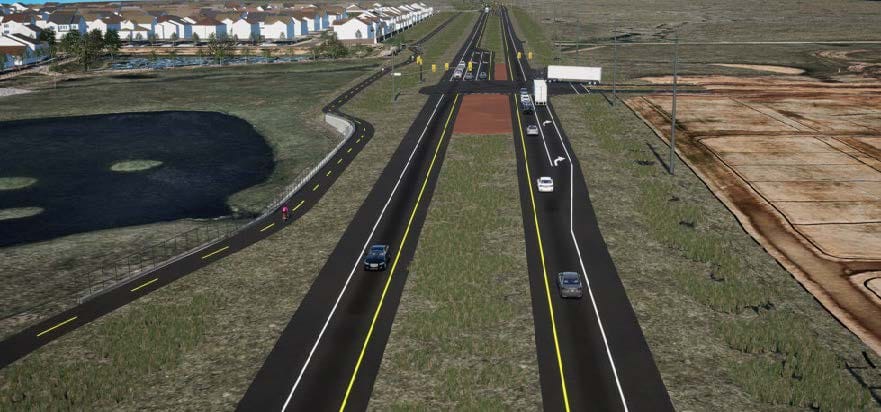
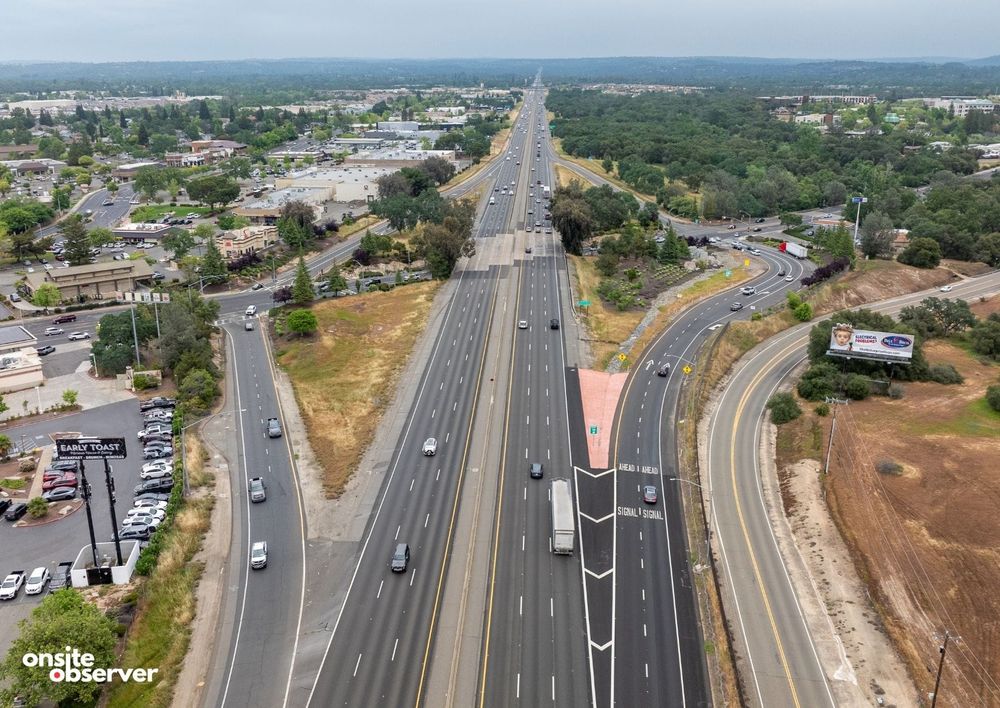
Video shows parts of completed section of Grant Line Road and sections planned for reconstruction. Captured July 4, 2025.
The latest proposal would rebuild the existing two-lane road and add a separate walking and cycling path. It is an early construction phase compatible with the larger expressway plan.
“Existing condition is really just the terrain that is paved. It needs to be engineered, completely reconstructed,” Derek Minnema, executive director of the Capital SouthEast Connector Joint Powers Authority, told the board.
Minnema said growing passenger traffic now shares the road with trucks hauling freight and agricultural products. The pavement is failing, drainage is inadequate and drivers have little room to recover if they leave their lane.
“It is an old farm road built 50 to 60 years ago,” he said.
Grant Line also serves businesses supplying the region’s construction industry, including the Teichert Aggregates quarry and the Crete Crush recycled-aggregate facility. Some large trucks must cross into opposing lanes or leave the pavement to make turns, according to the Connector agency’s funding proposal. The reconstruction would improve those turns and move the Teichert entrance to a signalized intersection.
The proposal lists 28 crashes along the project section from 2019 through 2023, including one fatal crash and two involving severe injuries. Preliminary figures for 2024 add four crashes, including a fatal rollover.
Authority board member Siri Pulipati recalled her own crash on Grant Line Road, calling it “one of the scariest days for my family.”
Plans call for a median separating opposing traffic, shoulders, improved drainage and removal of a sharp curve near the quarry. Utility poles and other roadside obstacles would be moved to give drivers more room to recover. The separate walking and cycling path would extend for the full 3.6 miles.
Thursday’s vote authorized an application to California’s competitive Local Partnership Program. The California Transportation Commission will decide which projects receive funding next year.
The Connector agency was awarded a $25 million federal RAISE grant in 2024. The federal grant would supply the dollar-for-dollar match for the requested state award.
Together, the two grants would cover $50 million of the approximately $53.8 million construction budget. The funding plan also includes $1.8 million in committed local construction money and a separate, pending $2 million request through the Sacramento Area Council of Governments for construction management and support. About $12.5 million has been committed to environmental work, design and land acquisition.
Grant Line was the only eligible proposal submitted for the transportation authority’s nomination. The project will compete for funding statewide.
“While there may not be competition locally, we are competing against the entire state,” Minnema said, citing competition from Los Angeles, the Bay Area and the Central Valley.
Design is about 90% complete, and land acquisition is underway. The agency’s schedule calls for completing design and securing the necessary property rights in summer 2027, with construction targeted to begin in May 2028.
Applications are due Nov. 18. The commission is scheduled to select projects June 24-25, 2027.
Want our stories first on Google? Add Onsite Observer as a preferred source.
Add us on Google →
Comments
What’s your take? Share your thoughts with other readers.