Sacramento region homeownership reaches highest rate in nearly 45 years
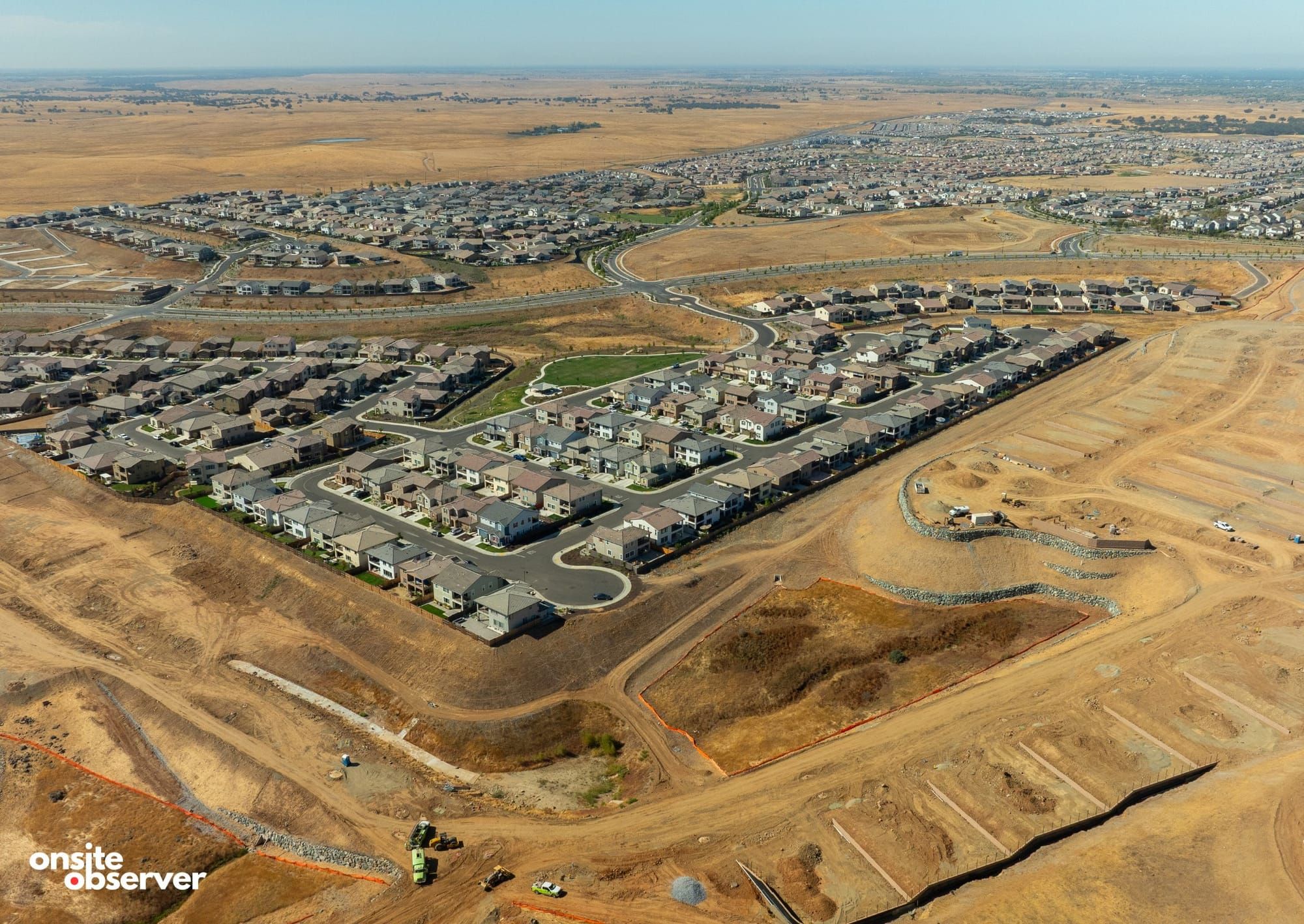
Homeownership in the six-county Sacramento region has climbed to its highest level in over four decades, even as high prices, elevated mortgage rates, and weak affordability continue to keep many local households out of the market.
A new analysis by the Sacramento Area Council of Governments (SACOG) found that nearly 64% of occupied households in the region were owner-occupied in 2024, the highest rate in SACOG’s data series dating back to 1980. The figure is based on U.S. Census Bureau American Community Survey data and includes households that own their homes outright and those still paying a mortgage.
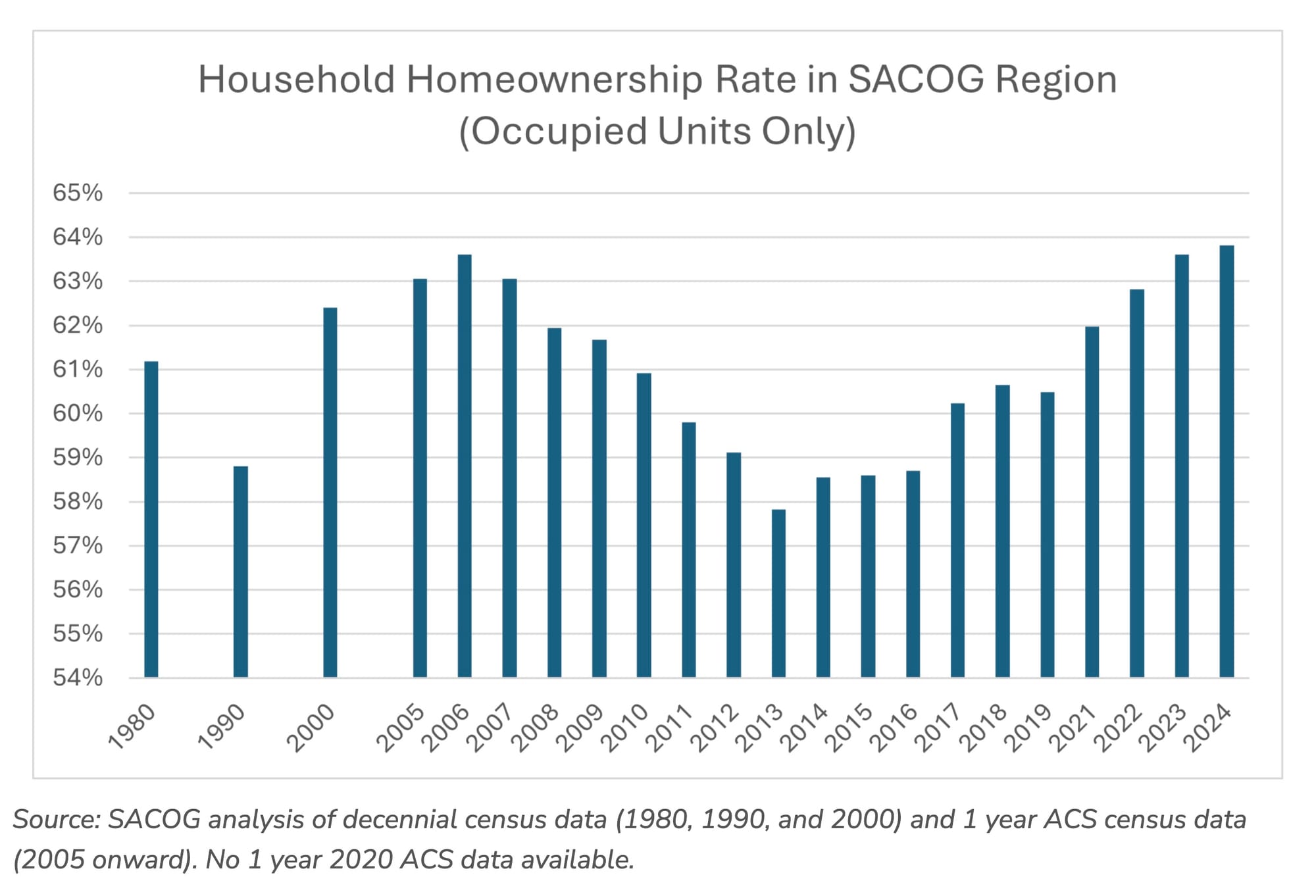
Unlike California and the nation as a whole, where homeownership rates have mostly stalled since 2021, the Sacramento region has continued to move upward, according to SACOG.
Regional officials attribute the sustained uptick to consecutive years of leading housing production and an influx of relatively high-income migrants fleeing expensive coastal markets. Adjusted for population size, the Sacramento region has led the state in housing production for eight consecutive years.
"We are sort of a relative affordability safe haven," Dov Kadin, SACOG senior planner, said in an interview. "As some of these coastal markets have become untenable for a lot of households, people are leaving because it's not very affordable."
Kadin said that while California historically exported its lower-income households due to displacement, recent trends show a sizable increase in higher-income households leaving coastal areas. A recent California Policy Lab report found that the share of Californians leaving the state from higher-income communities increased by 6.4 percentage points between pre-pandemic and post-pandemic periods. While the report focused on people leaving California for other states, Kadin said the same underlying pressure helps explain why the Sacramento region remains attractive to households leaving more expensive parts of California.
Garett Ballard-Rosa, a principal data analyst at SACOG, said Bay Area migration into the Sacramento region peaked during the pandemic and has since slowed. But SACOG’s recent migration analysis suggests the households still arriving from the Bay Area may be more affluent than earlier waves of movers, giving them more buying power in the Sacramento market.
“I don’t think there’s necessarily more Bay Area people moving in,” Ballard-Rosa said. “But those moving in are a bit more affluent than they have been in the past, and they are really able to translate that income into homeownership potential here in our region.”
Despite the gains in homeownership rate, the region continues to grapple with severe affordability and equity challenges.
Recent data from the National Association of Home Builders found that more than 70% of households in the Sacramento region are priced out of the new-home market. SACOG’s own data indicates that well over a third of households in the region are housing-cost burdened, meaning they spend at least 30% of gross monthly income on housing. Renters are under the most pressure, with more than half spending above that threshold. The average monthly rent across the region is $2,210.
Homeownership also remains uneven across the region. The highest rates are concentrated in more affluent, suburban, and rural areas. Unincorporated Placer County had an 84.2% homeownership rate, followed by Lincoln at 83.9%, unincorporated El Dorado County at 82.7%, Galt at 77%, and Elk Grove at 73.8%, according to SACOG’s analysis of five-year census data.
Those areas also have housing stocks dominated by single-family detached homes. In Lincoln, 91.5% of the housing stock is single-family detached. In unincorporated El Dorado County, the figure is 92%. The regional average is 72%.
The mix of homes being built helps determine who can buy. Large single-family homes on traditional lots remain expensive to deliver, especially after land, infrastructure, fees, and construction costs are factored in. Smaller homes, townhomes, condos, and other ownership options could give more first-time buyers a way into the market, SACOG officials said.
“The only way that you deliver more affordable homeownership opportunities is you have smaller homes on smaller lots, or a condo,” Kadin said.
But building those products has been difficult. Kadin said roughly 90% of multifamily housing in California is built as rental housing, not for-sale housing, in part because of construction-defect liability rules. Those rules can expose builders to lawsuits over alleged defects years after a condo project is completed, with some claims allowed for up to 10 years after substantial completion. That can raise insurance costs and make ownership projects riskier to finance and build.
Ballard-Rosa said moving more renters into ownership will require both regional work and state-level changes that make it easier to build missing middle housing, condos, and other smaller ownership products.
“It’s continuing that momentum of housing product type options,” Ballard-Rosa said. “Without that piece, that’s going to be really hard to break into homeownership.”
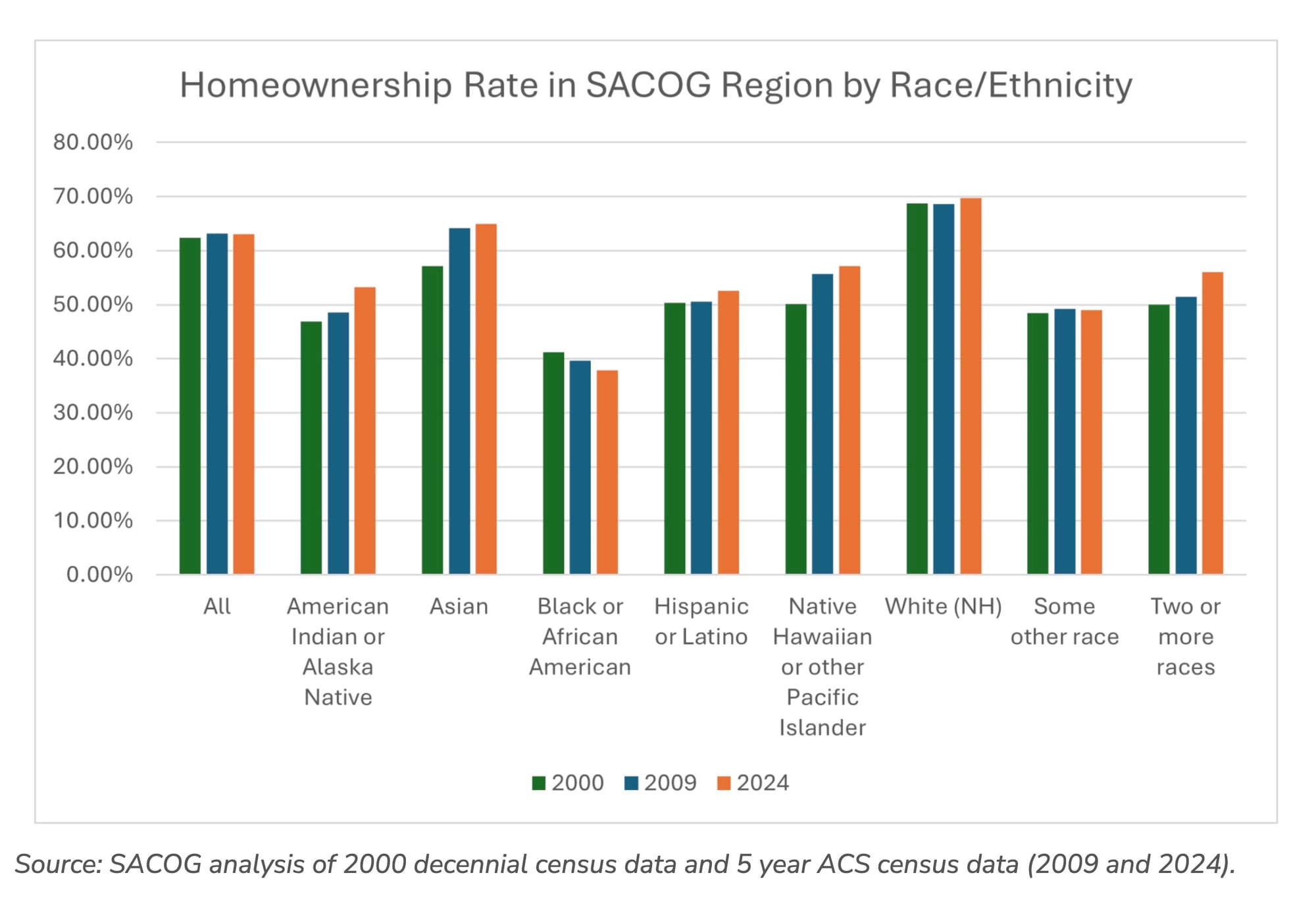
SACOG’s analysis also shows deep-rooted disparities by race and ethnicity continue to persist. While homeownership among Asian American households has risen over the last 25 years, the gap for Black and African American households may have widened. White households maintain homeownership rates near 70%, while rates for Black and African American households remain significantly lower at roughly 40%. Hispanic or Latino household homeownership sits slightly above 50%, and Asian American homeownership tracks closer to 65%.
To increase affordable ownership opportunities, local leaders have pushed to diversify the housing stock. The region’s Green Means Go program, which supports housing and infrastructure planning in designated growth areas, has helped cities and counties prepare for more infill and transit-oriented development. Kadin said annual housing permits in those green zones have increased 300% since the program was created about five years ago, with much of that growth driven by multifamily projects.
“You have 26 of the 28 jurisdictions that have adopted those green zones, which is phenomenal,” Ballard-Rosa said. “And you have the work through Green Means Go of helping fund those planning efforts.”
Kadin said the region is not trying to eliminate suburban housing choices, but to create more options for different types of households.
"It is really important to have the options. If we do not have options for people, they will bid up the price of the other housing units, and that's bad for everybody."
Author

Vitaliy Moskalenko is a development reporter passionate about documenting how communities grow. Through Onsite Observer, he delivers site visits, drone footage, and research-driven stories that bring transparency and context to local development.