Sacramento County has added $24.7 million in overdue utility charges and penalties to property tax bills, nearly 24% more than last year.
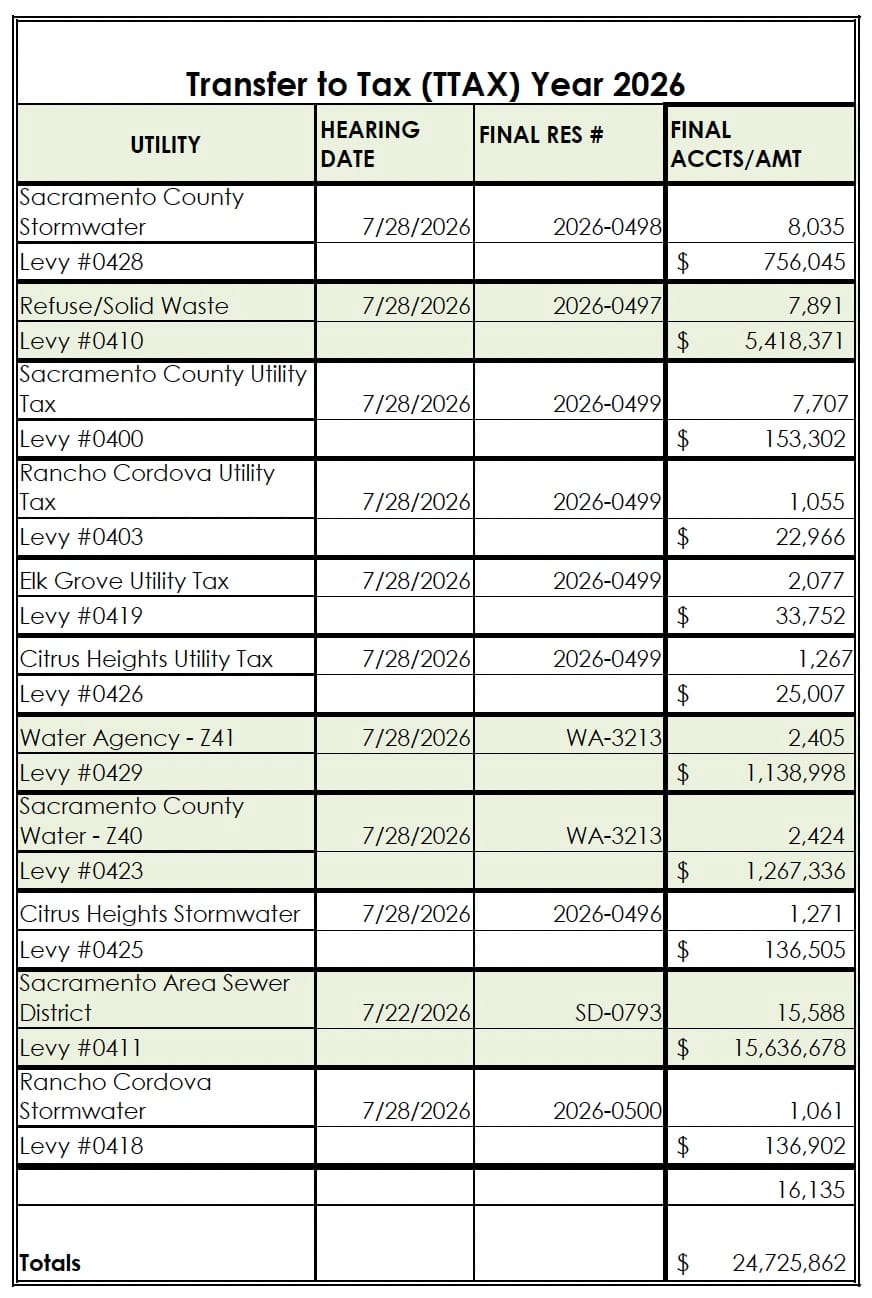
The transfers covered 16,135 accounts, according to a summary table in a county Department of Finance report filed with supervisors Nov. 3.
Property owners who fell behind on sewer, garbage, water and other utility bills will now have that debt collected through their property tax bills. The overdue balances appear as separate charges, in addition to the property taxes owed.
The total includes related utility taxes and a 10% penalty imposed when unpaid charges are transferred for collection.
The amount grew by $4.77 million from $19.95 million in 2025. It was the highest total in the report’s five-year comparison, up about 70% from 2022.
Sewer bills accounted for nearly two-thirds of the debt, or $15.64 million. That amount rose 25.7% in a year, while the number of delinquent sewer accounts increased about 5%, from 14,839 to 15,588. The average balance transferred per sewer account climbed from about $838 to $1,003.
Unpaid garbage charges rose 20.2% to $5.42 million, covering 7,891 accounts. Water debt reached $2.41 million, up 25.6%.
The service counts overlap. For example, a property with unpaid sewer and garbage bills can be counted in both categories.
The individual service counts add up to 50,781. The report does not explain how it arrived at the 16,135 total. Onsite Observer asked the county’s public information office how that total was calculated and how much of the 2025 and 2026 transfers has been collected, but did not receive a response by publication time.
Utility rates have risen, too, though the report does not explain how much of the increase in unpaid debt came from higher bills, longer periods of nonpayment or changes in collection practices.
For a single-family property receiving both sewage collection and treatment from the Sacramento Area Sewer District, the combined monthly bill rose from $63.35 to $69.35 in July 2025, an increase of about 9.5%. It went up again to $74.35 in July 2026 under the district’s adopted rate schedule.
The July 2026 increase came after the March 1 cutoff used to identify delinquent accounts for this year’s transfers.
The county’s standard 60-gallon garbage service rose about 4.1% in July 2025, from $39.41 to $41.03 a month. That charge covers garbage, organics and recycling collection, according to the county’s rate schedule.
The transfer to property tax bills follows months of notices to customers. Under the process described in the Finance Department report, an account becomes delinquent after 45 days of nonpayment. The county identifies accounts delinquent as of March 1 and warns customers that unpaid charges will be placed on their property tax bills.
Customers receive at least two more billing notices over the next four months. Balances that remain unpaid are transferred with the additional 10% penalty.
Property owners are responsible for county utility charges, including at rental properties. The county advises owners to receive and pay the bills themselves rather than have them sent to tenants.
Supervisors did not take a new vote on the transfers Nov. 3. The report documented transfers already authorized that summer: July 28 by the county and Sacramento County Water Agency boards, and July 22 by the sewer district board.
Another garbage rate increase is now pending. The county proposes raising the standard 60-gallon charge from $41.03 to $42.88 a month on Jan. 1, 2027, with annual increases through 2031. Supervisors are scheduled to hold a hearing Dec. 8.
County officials say equipment, fuel, labor and regulatory costs have outpaced current rates. Waste Management and Recycling receives no county general fund support and relies on customer charges, facility fees and program revenue. The proposal would also expand included bulky-waste pickups from one to two appointments in a rolling 12-month period, according to the county’s explanation.
Some residents may qualify for lower utility bills. County garbage and water programs offer monthly credits to customers enrolled in SMUD’s Energy Assistance Program Rate or PG&E’s CARE program who meet other county eligibility requirements. Water assistance also requires homeownership. The sewer district has a separate Sewer Lifeline program.
Customers can check eligibility through Consolidated Utilities Billing and Service at 916-875-5555.
Want our stories first on Google? Add Onsite Observer as a preferred source.
Add us on Google →
Comments
What’s your take? Share your thoughts with other readers.