Sacramento weighs zoning changes to allow more small multi-unit homes across the city

Sacramento city planners and design commissioners are weighing a zoning overhaul that could trade neighborhood “character” for the “missing middle” housing density needed to curb a regional housing shortage.
At a March 26 workshop, the Sacramento Planning and Design Commission reviewed proposed changes to the city’s zoning code as Sacramento moves to bring the code into compliance with the 2040 General Plan, adopted in 2024.
The proposed zoning would replace conventional unit-per-acre density limits with floor area ratio, or FAR, a formula that determines how much building area can be placed on a site relative to lot size.
For neighborhoods traditionally zoned for single-family use, this change would effectively dissolve the “one lot, one house” rule. Under a unit-per-acre cap, property owners are restricted by the number of households allowed on a property. Under the FAR model, they are restricted only by the building’s total mass. In practice, a developer could choose to build a single 4,000-square-foot luxury home or a four-unit multiplex made up of 1,000-square-foot apartments on the same lot, provided the total square footage stays within the FAR limit.
FAR is calculated by dividing the total square footage of a building by the square footage of the lot, so a 5,000-square-foot building on a 5,000-square-foot parcel would equal an FAR of 1.0. Under the new zoning ordinance, the city would allow an FAR of 1.0 citywide, with intensities climbing as high as 15.0 near major transit areas.
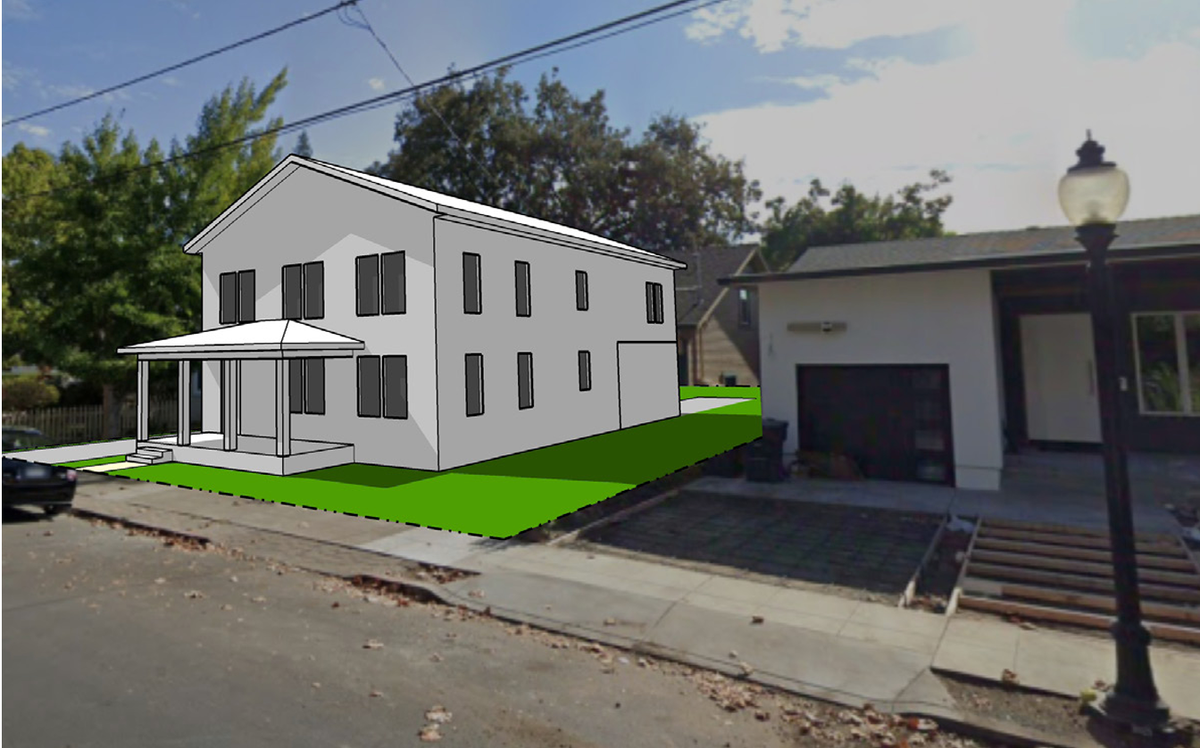
During the workshop, much of the discussion focused on missing middle housing, meaning duplexes, triplexes, and fourplexes designed to fit into single-family neighborhoods. They are often called “missing middle” because they fill the gap between single-family homes and larger apartment buildings, and because they can offer a lower-cost path to homeownership or renting in neighborhoods where detached houses are often out of reach.
City staff proposed a moderate approach to implementing the new ordinance, one that would balance the general plan’s mandate for density with the need to recognize the scale and development patterns of existing neighborhoods. That would mean staff-level approval for projects that meet the city’s development standards, while projects that exceed those standards would still have to go through a director-level public hearing.
For housing advocates representing House Sacramento, a local “Yes In My Backyard” (YIMBY) organization, the staff's moderate recommendation did not go far enough. Speakers including the group's president, Michael Turgeon, and members Ben Raderstorf, and Nolan Gray, argued that Sacramento’s reliance on bulk controls is a primary reason missing middle projects fail to pencil out financially. Raderstorf explicitly urged the commission to get rid of bulk control, describing it as a tool used to protect the status quo at the expense of those currently living on the streets.
Speakers said the rules often force builders into awkward designs that mimic the shape of detached houses instead of allowing more efficient multi-unit construction.
“I think we just need to sometimes make it legal to build a box,” Vice Chair Kaden said, arguing that Sacramento should allow simpler rectangular three-story buildings instead of forcing small projects into more expensive house-like forms with pitched roofs, dormers, and gables. He said that a year and a half into the interim ordinance, the city still had not seen the kind of three- to 10-unit projects it was meant to encourage. “Based on the conversations that I’ve had with small developers, the biggest constraint in the interim ordinance that they identified were rules like bulk control that make three-story construction more expensive,” he said.
Urban Design Manager Bruce Monighan acknowledged the surprise at the low application numbers, attributing the stagnation to the high cost of moving from residential to commercial building codes once a project exceeds three units.
As of Feb. 26, city staff reported that 32 missing middle applications had been submitted, including 19 approvals, nine in progress, four withdrawals, and no denials. The approved building types shown in the staff presentation were dominated by single-unit dwellings, duplex dwellings, and larger multi-unit dwellings of 20 or more units.
The city is also preparing for the July 1 implementation of Senate Bill 79, a new state law that establishes statewide zoning standards for housing near transit. In some cases, SB 79 allowances would exceed the city’s General Plan, permitting heights of up to 85 feet for parcels within 200 feet of major transit stops.
Staff recommended codifying those height standards directly into the city’s commercial and high-intensity residential zones to prioritize development along major corridors.
The commission also reviewed a framework for “Cottages on Wheels,” or COWs — towable, factory-built homes between 150 and 400 square feet. Unlike temporary shelters, they are intended as permanent housing, registered with the DMV and connected to city utilities.
“This is the fastest, least expensive way to build housing,” Monighan said, estimating that these units could be built for half the cost of a traditional accessory dwelling unit, or ADU.
During public comment, Maximilian Rosa, director of sustainability at Sierra Service Project, stated his organization builds the cottages for an average of $30,000 each. Robin, a primary COW dweller from West Sacramento, testified that her own unit was purchased for $40,000, offering a rare entry point into homeownership.
Advocates urged the city to allow COWs as primary residences on vacant lots. Commissioner Yeung noted the potential for COWs to serve as a low-cost transitional housing strategy if permitted.
The city will continue its analysis through the spring, with a workshop scheduled for the City Council on April 14. Community engagement will follow in the summer, with final adoption of the updated zoning ordinance anticipated by winter 2026.
Support our work and unlock all articles, project updates, and subscriber-only insights by subscribing to Onsite Observer.