California’s billion-dollar Capitol Annex project pushes forward amid rising costs and scrutiny.

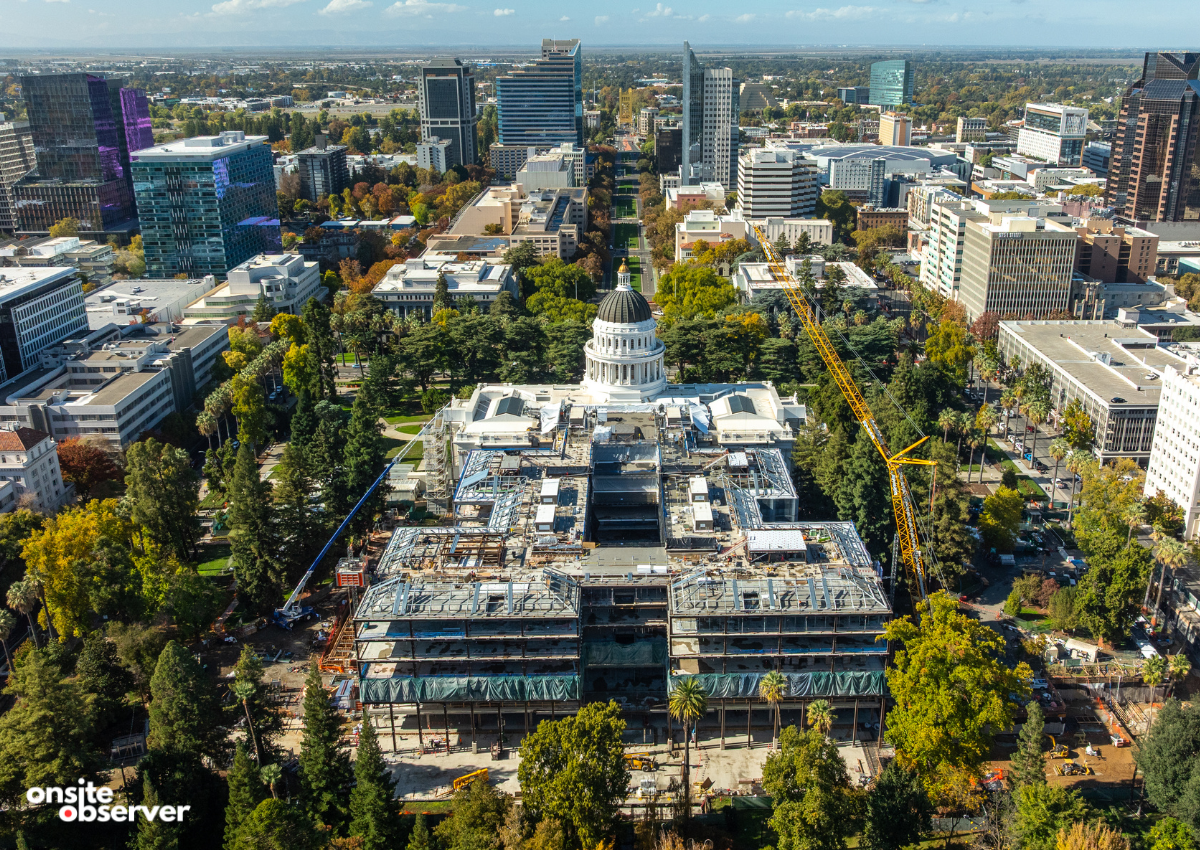
The transformation of California’s State Capitol building is now impossible to ignore. Behind the white dome, cranes tower above steel framing where the new Capitol Annex is rising — a billion-dollar rebuild reshaping one of the state’s most recognizable landmarks.
The six-story structure is replacing the 1950s office wing that once housed lawmakers, staff, and the governor’s suite. That building was demolished in 2022 after years of debate over its safety, accessibility, and outdated systems. In its place, a modern, glass-clad building is taking shape, designed to bring the Capitol into compliance with today’s structural and accessibility standards.
When complete, the new complex will total approximately 525,000 square feet, featuring upgraded hearing rooms, legislative offices, and mechanical systems that meet the state’s strict requirements for seismic safety, energy performance, and ADA compliance.
Video footage shows the latest construction progress on California’s Capitol Annex project.
When the Legislature first approved funding in 2016 under Senate Bill 836, the project was intended as a modernization of the existing structure. But by 2018, lawmakers had approved a full rebuild, estimated at the time to cost between $500 million and $750 million. State officials argued that replacing the structure entirely would be more cost-effective and efficient than attempting a retrofit.
As with so many state projects, the execution has proven more complicated than the concept.
By 2025, the project’s cost had surpassed $1.1 billion, according to internal estimates and investigative reporting, placing it among the most expensive public construction efforts in California history.
The project’s story runs deeper than its architectural ambition. Since its approval, the Capitol Annex rebuild has been shadowed by questions about transparency and accountability.
The demolition of the old building and the removal of mature trees from Capitol Park fueled lawsuits and public opposition. Environmental groups and preservationists warned that Sacramento was losing more than an office wing — it was losing a piece of its history.
Most recently, attention has turned to how the project is being funded and managed behind closed doors.
KCRA’s investigations revealed that despite the billion-dollar price tag, lawmakers have provided no comprehensive breakdown of expenditures and have not held a public briefing on total costs since construction began. Nearly every contractor and consultant involved has signed a nondisclosure agreement barring them from discussing details of the project’s scope, cost, or internal decision-making — a practice state officials defend as necessary for security but which critics say undermines public trust.
Despite ongoing scrutiny over transparency, construction progress continues. Today, steel framing has reached its full height, and the skeletal outline of the new Annex shows its full scale. The building is now transitioning toward enclosure as crews prepare to install exterior glass panels.
According to the Department of General Services, the project is expected to reach structural completion in 2026, with full occupancy targeted for 2027. Once finished, the new facility will connect directly to the historic west wing through a below-ground corridor, integrating the entire Capitol complex.